Craig Group Ignite™: Turning Strategy Into Revenue

You’ve got the roadmap. Now what?
This is where many strategic initiatives get stuck. You know what needs to be done: target more precisely, improve sales materials, generate leads consistently, and use a CRM that truly supports your sales. The plan is clear, and the priorities are set.
Six months later, very little has changed.
It’s not that the strategy was wrong. The real issue is your team was already working at full capacity before you asked them to transform your go-to-market approach.
That’s the gap Craig Group Ignite™ was built to close.
The Execution Problem No One Talks About
Most companies don’t fail because they lack a clear strategy. They fail because they can’t put it into action.
Your sales leader who should be documenting the new process is busy with back-to-back calls to close this quarter. The marketing person who could build your content engine is tied up with trade shows and handling customer issues. The operations person who should be improving your CRM is overwhelmed with board reports.
Everyone is busy and doing their best, but real change keeps getting delayed until the next quarter.
Even if your team had more time, they probably haven’t built these systems before. It’s not about their intelligence. Knowing you need better lead qualification is one thing; actually creating frameworks that people use is another. Understanding the need for content marketing is different from building editorial calendars, improving SEO, and producing content that works.
You could hire someone with this expertise, but that process takes 6 to 12 months for recruiting, interviewing, onboarding, and training. If you make the wrong hire, you lose a year.
This is where Ignite comes in.
What Ignite Actually Is
Think of Ignite as your starter execution team.
You have strategic clarity – from our Catalyst™ engagement, from internal strategy work, from board discussions where everyone agreed “we need to fix this.”
Ignite means Craig Group works directly with your team to handle the hands-on tasks. We implement your CRM, create sales playbooks, build campaigns, produce content, train your team, and make improvements based on real data.
Once everything is working and you see results, we hand over those capabilities to you. Sometimes that means hiring someone internally. Sometimes your current team takes over a proven system. In some cases, we stay involved for strategic projects while your team manages daily operations.
The goal: Build it. Prove it works. Make it yours.
Two Sides of Ignite: Sales vs. Marketing
Ignite is not a one-size-fits-all solution. The priorities for execution depend on your main challenge.
Some companies need to improve their sales process. They generate leads but struggle to convert them, or they win deals that are not profitable. They have a sales team that just needs more focus, better processes, and improved tools.
We worked with a Texas-based contract manufacturer in a situation exactly like this. They were generating 2 new leads per month with a 15% win rate and $30K average deals, in a market where offshore competitors were undercutting them on price and PE backers wanted growth.
After defining their strategic focus on higher-margin sectors, we moved to execution: created qualification frameworks, built sales materials that differentiated on value, not price, restructured their CRM from a reporting tool into pipeline management, launched targeted campaigns, and redesigned comp to reward the right deals.
Results: 14 leads per month (up 600%), 38% win rate (up 153%), $68K average deals (up 127%). Same team. Same market. Different system.
Other companies need marketing infrastructure from scratch. They have sales capacity but no qualified pipeline, no brand presence and no systematic way to generate demand.
FHAS, a provider of Independent Dispute Resolution services, had this challenge. Ninety percent of their business came through government referrals – they had almost zero control over growth. Domain authority under 10. No CRM. Leadership spent 3-4 days weekly on manual reporting.
After defining their strategy – position as the informational authority, build multi-channel presence – we built the infrastructure: overhauled their website, created an educational resource hub, implemented HubSpot with full attribution, launched segmented email and LinkedIn campaigns, and built automated dashboards.
Results: revenue doubled, domain authority jumped to 22, email open rates hit 50-80%, they became a recognized authority in their space. And then, they hired a marketing director to own and scale what we’d built.
Do you see the pattern? Both companies improved several areas at once – not just lead volume, but also conversion rates, deal sizes, and how efficiently they worked. That’s what leads to compounding growth.
Multiple Levers, Compounding Results
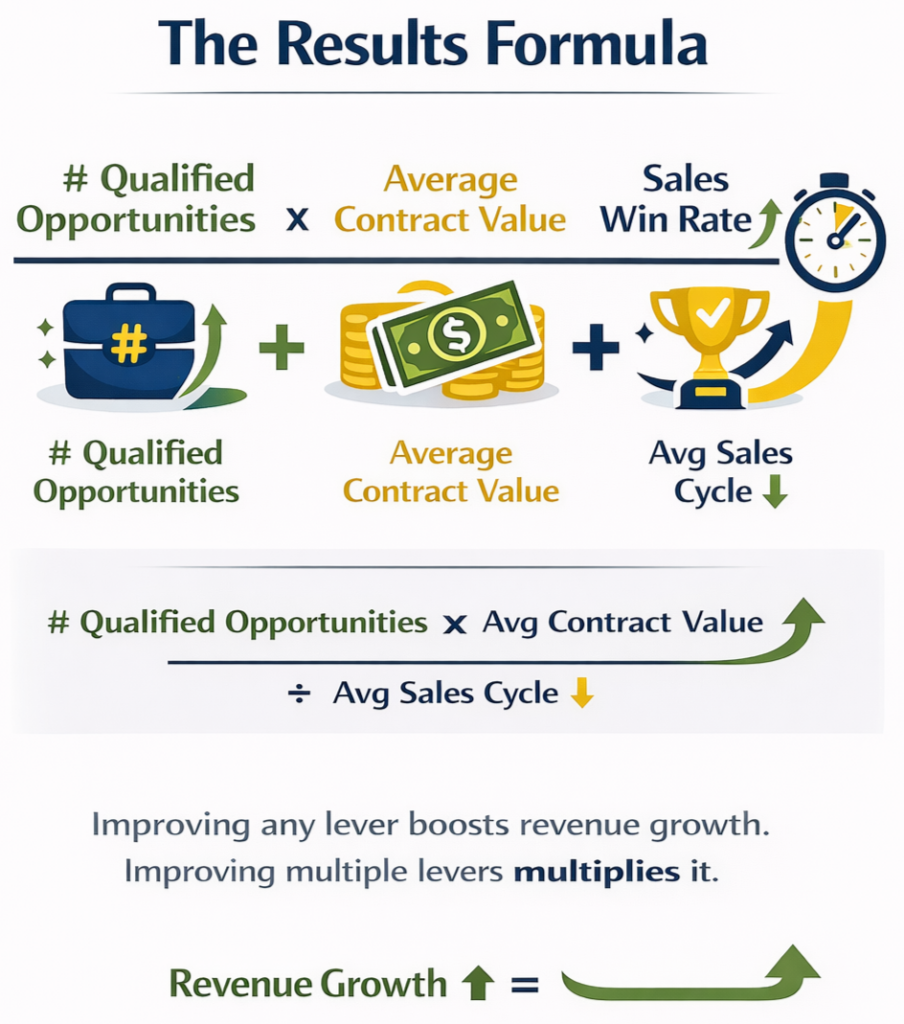
Remember this formula?
Revenue Growth = (# Qualified Opportunities × Average Contract Value × Sales Win Rate) ÷ Average Sales Cycle
If you improve just one area, you see some growth. But when you improve several areas at the same time, the results multiply.
The contract manufacturer didn’t just get more leads. They got more leads, higher win rates, and bigger deals. Three levers improving simultaneously.
FHAS didn’t just fix their website. They built a website, a content engine, a CRM, multi-channel campaigns, and automated reporting. Five capabilities coming online together.
This is why Ignite gets results. We don’t just do marketing or fix sales. We build the key capabilities your business needs and show that they work with real, measurable results.
What Actually Happens During Ignite
Every project is tailored to your needs, but we follow a consistent process:
Weeks 1-6: Foundation
We review everything – your systems, your data, and how your real processes compare to what’s documented. We agree on priorities, set up ways to measure and track progress, and begin building the core infrastructure.
For FHAS, this meant realizing that contact management in Outlook prevented them from seeing patterns across accounts. For the contract manufacturer, it meant discovering their sales team couldn’t articulate why they were better than offshore competitors.
Weeks 7-16: Build and Launch
This is hands-on-keyboard work. Implementing or restructuring CRM. Creating sales materials and playbooks. Producing content. Launching campaigns. Training teams. Setting up dashboards and attribution.
Weeks 17-24: Optimize and Transition
Now we have data. We see what’s working and double down. We adjust what’s not. And we transition ownership, whether that’s hiring someone internal (like FHAS did), keeping Craig Group on retainer for strategic work, or moving everything in-house with full documentation and training.
Sometimes integrations take more time. Sometimes campaigns don’t perform as expected, so we adjust. But we move quickly because we have experience and know how to avoid common pitfalls.
Who This Is For
Ignite makes sense if:
You know what needs to happen, but lack execution muscle. You have strategic clarity – you need help doing the work.
Your team is already busy running the business. They can’t transform it at the same time, and you know that adding more to their workload will slow progress to a crawl.
You need results in a few months, not years. Maybe you have a private equity timeline, a board presentation coming up, or you’re preparing for an exit. You can’t afford to spend a year hiring and training.
You want to see proof before taking full ownership. Build the system with Ignite, show that it works, then hire someone to take over. This is much less risky than hiring first and hoping for the best.
Ignite may not be right if you’re still working out your strategy – you’ll need Catalyst first. It’s also not for those who want completely hands-off outsourcing, since Ignite is collaborative. And if your team won’t support new processes, execution will be tough.
What Happens After
Three common paths:
You hire someone internally. For example, with FHAS, we built the marketing engine, showed it worked, helped them hire a director, trained them, and then stepped back. This way, you reduce risk because your new hire is improving a proven system, not starting from zero.
You keep us on retainer. Your team manages daily operations, while Craig Group takes care of strategic projects like launching new markets, running major campaigns, or overhauling your sales process. You get expert help without the cost of a full-time hire.
You layer in Conduit™. Our revenue planning platform uses your data to model different scenarios. For example, what happens if you double your ABM spend, hire two more reps, or expand into a new market? It shows exactly how these choices affect your revenue, EBITDA, and exit multiple.
The Unglamorous Truth
Here’s what we’ve learned: knowing what to do is not the hard part. The real challenge is putting in the steady work to actually build it.
But that’s where growth really happens. It starts with the strategy and continues with the daily work of building systems that add up over time.
Are you ready to close your execution gap? Let’s have a conversation.